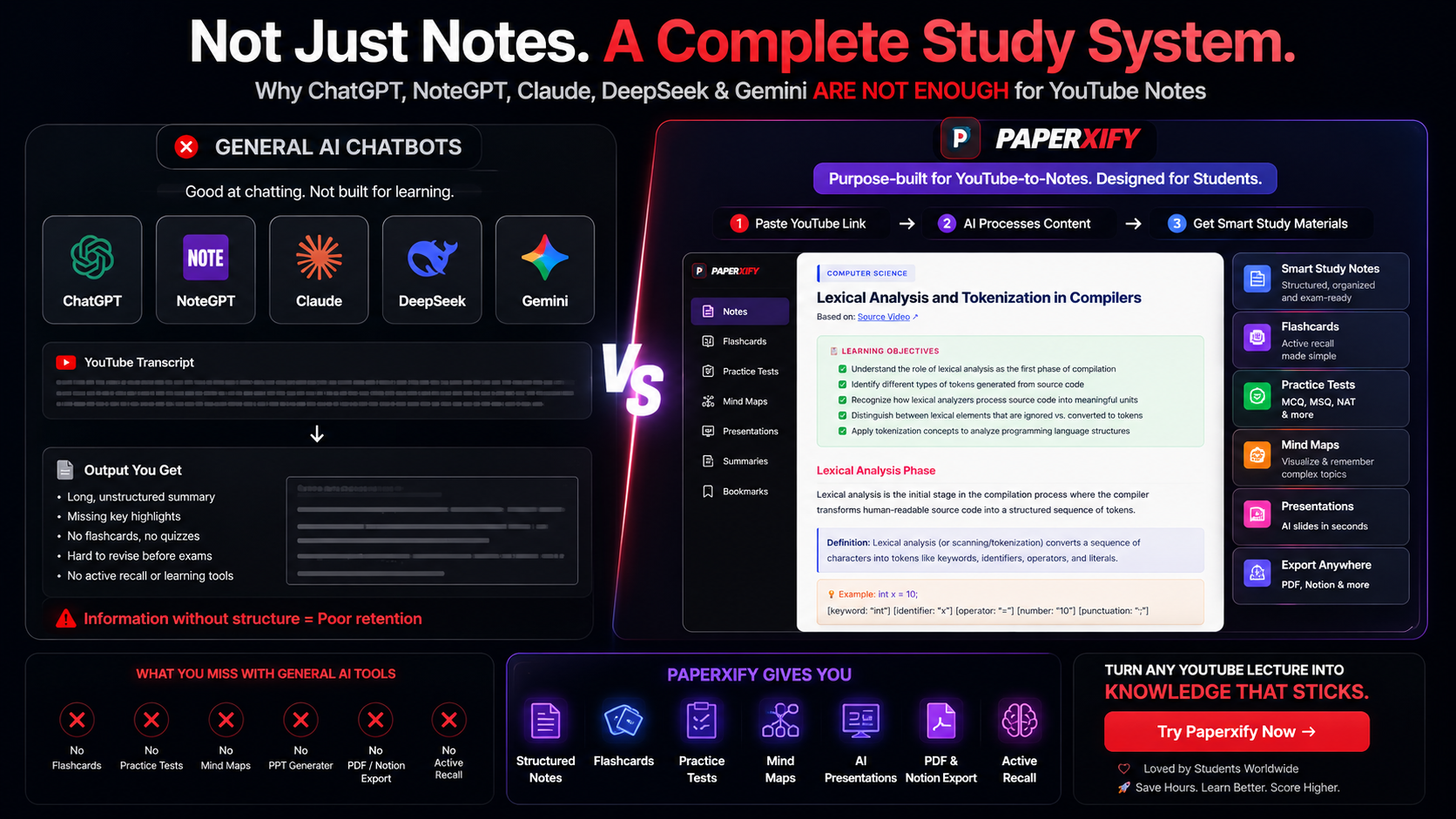
Most AI tools can summarize a video. Very few can transform a lecture into a complete study system. Here's why purpose-built learning platforms are changing how students learn from YouTube.
Over the last few years, AI has completely changed how students consume educational content. Instead of manually taking notes from a two-hour lecture, many students now paste transcripts into ChatGPT, Claude, Gemini, DeepSeek, or NoteGPT and ask for a summary. While this approach is certainly faster than writing notes from scratch, it often leaves students with a different problem: information without structure.
After experimenting with nearly every popular AI tool available, I noticed a common pattern. Most platforms are incredibly good at generating text. However, they are not specifically designed for academic learning workflows. They can summarize content, but they often struggle to transform educational material into something students can actually study from efficiently.
# The Hidden Problem With Generic AI Note Generation
When students paste a YouTube transcript into a general-purpose AI chatbot, the result is usually a large block of summarized text. While this may seem useful initially, several problems quickly emerge during revision.
- Important concepts are often buried inside long paragraphs
- Definitions and key terms may not be highlighted clearly
- Exam-focused questions are rarely generated automatically
- Students still need to create flashcards manually
- There is no built-in active recall workflow
- Visual learning aids are usually missing
- Exporting notes into study-ready formats often requires extra work
The reality is that studying and summarizing are not the same thing. A summary helps you review information. A study system helps you retain information.
# Why Students Use YouTube As Their Primary Learning Platform
Today, millions of students rely on YouTube to learn programming, mathematics, biology, chemistry, physics, economics, business, medicine, engineering, and countless other subjects. Educational channels often provide explanations that are easier to understand than traditional textbooks.
The challenge begins when students need to revisit that information before an exam. Rewatching hours of content is inefficient. Manually creating notes can take longer than the lecture itself. This is where AI note generation becomes valuable—but only if the output is optimized for learning.
# Comparing Popular AI Tools For YouTube Notes
| Feature | Paperxify | ChatGPT | Claude | DeepSeek | Gemini |
|---|---|---|---|---|---|
| YouTube Link to Notes | Yes | Manual Workflow | Manual Workflow | Manual Workflow | Partial |
| Academic Formatting | Advanced | Basic | Basic | Basic | Basic |
| Flashcards | Yes | No | No | No | No |
| Practice Tests | Yes | No | No | No | No |
| Mind Maps | Yes | No | No | No | No |
| PDF Export | Yes | No | No | No | No |
| Student Focused | Yes | General AI | General AI | General AI | General AI |
# What Students Actually Need From AI
When preparing for exams, students need much more than a summary. Effective learning requires retrieval practice, spaced repetition, active recall, and structured revision materials. These are the principles that educational psychology consistently associates with long-term retention.
A useful study tool should automatically transform a lecture into multiple learning formats. The same content should be available as notes, flashcards, quizzes, revision summaries, mind maps, and presentations.
"The goal isn't to create more content. The goal is to remember more of what you've already learned."
# Why Active Recall Changes Everything
One of the biggest weaknesses of traditional note-taking is that it encourages passive review. Students read the same notes repeatedly and assume they understand the material. Unfortunately, recognition is not the same as recall.
Active recall forces the brain to retrieve information without seeing the answer first. This process strengthens memory and improves retention significantly. That's why flashcards, quizzes, and practice tests consistently outperform passive reading when preparing for exams.
- Flashcards improve memory retention
- Practice tests reveal knowledge gaps
- Quizzes simulate exam conditions
- Active recall strengthens long-term learning
- Immediate feedback accelerates improvement
# The Difference Between A Chatbot And A Study Platform
General-purpose AI assistants are designed to answer almost any question. They are excellent conversational tools. However, because they are designed for everyone, they are rarely optimized for a specific educational workflow.
A dedicated learning platform approaches the problem differently. Instead of asking students to engineer prompts, copy transcripts, organize notes, create flashcards, and build revision materials manually, the platform handles those tasks automatically.
This distinction becomes especially important when studying large subjects such as computer science, engineering, medicine, economics, law, or business. A single course can contain dozens of hours of lectures and thousands of pages of information.
# From YouTube Lecture To Complete Study System
Imagine pasting a lecture link and instantly receiving structured notes, key concepts, learning objectives, flashcards, practice tests, mind maps, revision summaries, and presentation slides. Instead of spending hours organizing information, students can focus on understanding it.
- YouTube Video
- Structured Notes
- Flashcards
- Practice Tests
- Mind Maps
- Presentations
- PDF Export
# Built Specifically For Students
Many AI platforms are designed primarily for business productivity, writing assistance, coding, or general conversation. Educational use cases are often secondary features. Students require different workflows, different outputs, and different learning experiences.
Purpose-built educational platforms focus on learning outcomes rather than text generation. The objective is not to create the longest summary possible. The objective is to help students learn faster, revise smarter, and perform better during assessments.
# Who Benefits Most?
Students preparing for AP Exams, SAT, ACT, GCSEs, A-Levels, ATAR, HSC, university midterms, final exams, technical certifications, engineering entrance exams, medical entrance exams, and professional development programs can all benefit from structured learning workflows.
Subjects such as Computer Science, Biology, Chemistry, Physics, Mathematics, Economics, Psychology, Medicine, and Business Studies are particularly well suited to AI-powered note generation and active recall systems.
# Final Thoughts
ChatGPT, Claude, DeepSeek, Gemini, and similar AI assistants are remarkable technologies. They are powerful conversational systems capable of helping users across countless tasks. However, generating effective study materials from educational content requires more than conversation.
Students don't simply need summaries. They need a structured learning system that transforms information into understanding. The future of AI-powered education is not about replacing learning. It's about making learning more efficient, organized, and effective.
As educational content continues to move online, the tools that help students convert lectures into notes, flashcards, quizzes, mind maps, and presentations will likely become an essential part of the modern learning experience.
Written by Admin
Chief Editor
Expert contributor at Paperxify. Sharing insights on engineering, AI systems, and student success.